phyphox
Education- Category Education
- Size 8.5MB
- Requirements Android 0 and up
- Downloads 650,000,000+
- Package Name de.rwth_aachen.phyphox
- Content Rating Everyone
About phyphox feature
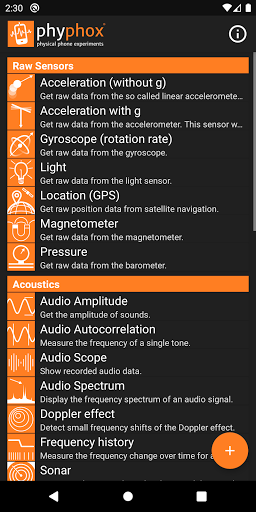
phyphox is a powerful mobile application developed by RWTH Aachen University that transforms smartphones into portable physics laboratories. By leveraging the built-in sensors in modern devices, it enables users to conduct a wide range of scientific experiments without specialized equipment. The app provides direct access to data from sensors like the accelerometer, gyroscope, magnetometer, light sensor, microphone, and pressure sensor, offering a practical tool for both education and personal exploration of physical phenomena in everyday environments.
Chapter 1: Function
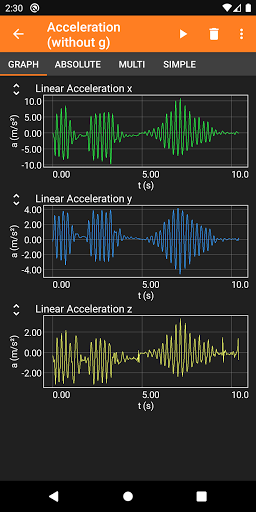
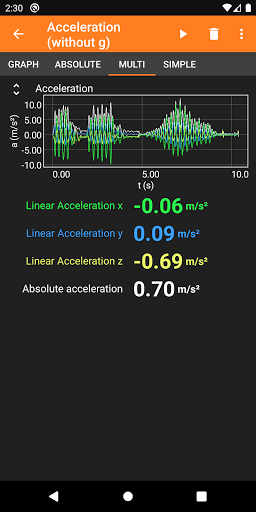
phyphox harnesses the sophisticated sensors embedded in smartphones to perform real-time physics experiments. Its core functionality revolves around data acquisition from multiple sensors simultaneously, including the accelerometer for measuring acceleration forces, gyroscope for rotation rates, magnetometer for magnetic field strength, and microphone for sound amplitude and frequency analysis. The app features pre-configured experiments such as pendulum period measurement, acceleration of a moving vehicle, speed of sound determination, and spectral analysis of audio signals. It allows for precise data recording with customizable parameters like sampling rate and duration. The interface enables real-time graphing of sensor data, data export in CSV format for further analysis, and remote control capabilities via a web interface, allowing experiments to be conducted and monitored from a computer browser.
Chapter 2: Value
The primary value of phyphox lies in its democratization of experimental physics, making sophisticated measurements accessible to anyone with a smartphone. It eliminates the need for expensive laboratory equipment, allowing students, educators, and enthusiasts to conduct meaningful experiments anywhere. For educational institutions, this represents significant cost savings while enhancing hands-on learning opportunities. The app bridges the gap between theoretical concepts and real-world phenomena by enabling immediate verification of physical principles in familiar environments. Its accuracy, when used appropriately, rivals that of dedicated educational sensors, with the accelerometer capable of detecting subtle movements and the gyroscope providing precise rotational data. The ability to export raw data facilitates deeper analysis and integration with other software tools. Furthermore, phyphox encourages scientific curiosity by lowering barriers to experimentation—users can spontaneously investigate the physics of their surroundings without preparation. The open-source nature of the project ensures continuous improvement and transparency, while the growing experiment library curated by both developers and users expands its capabilities continually. This combination of accessibility, precision, and versatility makes phyphox an invaluable tool for both formal education and informal scientific exploration.
Chapter 3: Scenarios
phyphox serves diverse user groups across multiple scenarios. Physics students from high school to university level constitute the primary audience, using the app for laboratory exercises, project work, and verifying theoretical concepts. Educators incorporate it into classroom demonstrations and assignments, enabling entire classes to conduct experiments simultaneously with their personal devices. Researchers utilize it for preliminary data collection and fieldwork where traditional equipment is impractical. Hobbyists and science enthusiasts employ phyphox to satisfy curiosity about everyday phenomena—measuring elevator acceleration, analyzing roller coaster dynamics, or studying smartphone vibrations. Common use cases include measuring gravitational acceleration through free-fall experiments, determining the speed of sound using two devices, analyzing oscillation patterns of springs and pendulums, investigating magnetic fields from household appliances, and conducting acoustic experiments with musical instruments. The app proves particularly valuable in remote learning situations, allowing students to perform meaningful experiments outside traditional labs. Its simplicity enables even younger students to engage with physics concepts through immediate, tangible measurements of their physical environment.